Cosmetic consultations
How the face changes with age, and why skin loosens
Your face is built in layers: bone, fat, ligaments, muscle and skin. Each changes with age at its own pace, and that is normal. This page explains those changes, why skin gradually loosens, what skin-based options can and cannot do for mild to moderate skin laxity, and what a cosmetic consultation at Oak in Underwood involves, including when no treatment or another practitioner may be a better fit.
Understanding it
How the layers of the face age
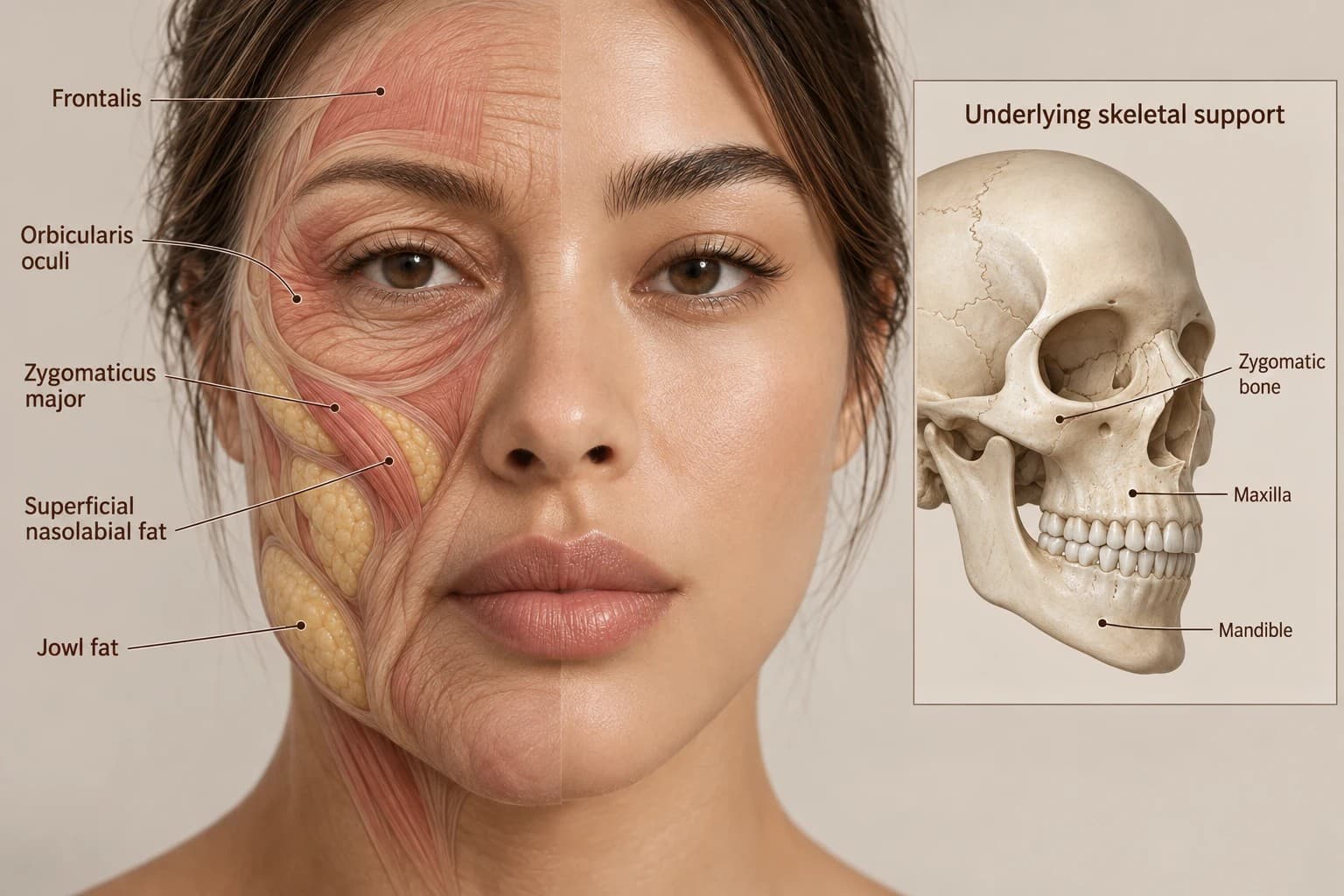
A face is built in layers. The skull and jaw form the framework. Over the bone sit deeper fat pads, then the muscles of facial expression, which are linked by a sheet of connective tissue. Above that is a layer of fat just under the skin, and finally the skin itself. Small fibrous bands called retaining ligaments pass from the deeper structures to the skin and help hold the layers in place.
Every layer changes with age. Imaging studies suggest the facial bones slowly remodel through adult life, particularly around the eyes, the upper jaw and the lower jaw, although findings vary between studies. Fat pads change at different rates, and weight change affects them too. Ligaments loosen, and skin makes less collagen and elastin. Together these changes can soften the jawline and, in some people, lead to jowls. The timing and pace differ widely between people.
Skin laxity means skin that has become looser and less able to spring back. It is a normal part of ageing, and there is no correct way for a face to age: faces vary with ancestry, sex and age, and most are slightly asymmetric. Because several layers are involved, skin-based treatments can only address part of these changes. Devices such as high-intensity focused ultrasound (HIFU) and radiofrequency (RF) act on the skin and the connective tissue beneath it, so they may suit some people with mild to moderate laxity, and any change is usually modest.
Contributing factors
What drives facial ageing and skin laxity
Bone
The facial skeleton slowly remodels through adult life. Imaging studies describe gradual change around the eye sockets, the upper jaw and the lower jaw, which alters the framework the soft tissues sit on.
Fat compartments
Facial fat sits in separate compartments rather than one continuous sheet. Ageing and weight gain or loss affect each compartment differently, which is one reason faces change gradually and unevenly over time.
Retaining ligaments
These fibrous bands anchor the soft tissues to deeper structures. As they and the surrounding tissues loosen, the tissue between them can sit lower, which is one reason jowls tend to form along the jawline.
Collagen and elastin
Collagen and elastin gradually decline through adult life. Sun exposure and smoking speed this up, and poor sleep may play a part, leaving skin thinner and less able to spring back. For help to stop smoking, call Quitline on 13 QUIT (13 7848).
Teeth and bite
Tooth loss, dentures and changes in bite can reduce the height of the lower face and change how it looks from the side. A dentist is often the right first opinion.
Genetics and life events
Inherited bone structure, ancestry, hormonal changes such as menopause, illness and significant weight change all influence how, and how early, these changes appear.
Your consultation
How we assess skin laxity and facial change
Your consultation is with Kirby Shannon (NMW0002042639), Registered Nurse (Division 1), general registration with the Australian Health Practitioner Regulation Agency (Ahpra). Kirby has more than ten years' experience in cosmetic and skin practice. She works within Oak's doctor-led team. The aim is to understand what is changing, at which layer, and whether any treatment is a sensible choice for you.
- Your face from the front, side and at an angle, in consistent lighting, to see how the skin and the deeper layers have changed
- Skin quality: thickness, elasticity, sun damage, pigment, skin type and any active skin conditions
- Whether skin laxity is present, for example along the jawline or upper neck, and how marked it is
- Features such as bone structure and bite, and whether a dentist, surgeon or dermatologist would be a better first opinion
- Your medical history, medicines, allergies, previous cosmetic procedures, and how your skin has healed in the past, including any tendency to scarring or pigment change
- Lifestyle factors such as sun exposure, smoking, sleep and recent weight change
- What you would like to change and why, and how the concern affects your daily life. We ask everyone some standard questions about appearance-related worry, and may suggest a general practitioner (GP) or psychologist where that could help
Approaches we may discuss
Options for skin laxity, including no treatment
Options are discussed only after assessment, and not every option suits every person. The skin and device services below work on skin quality and mild to moderate skin laxity, and results vary between individuals.
HIFU for mild to moderate skin laxity
High-intensity focused ultrasound (HIFU) directs ultrasound energy to set depths beneath the skin, creating small points of heat in the connective tissue. The aim is to prompt gradual collagen remodelling. It may suit some people with mild to moderate laxity of the lower face or neck. Any change develops over several months, and some people notice little or no difference.
Learn moreRadiofrequency (RF) skin treatment
RF uses controlled heat in the deeper layers of the skin to prompt collagen remodelling. It is usually planned as a course of appointments. For some people it may modestly improve skin firmness and texture over time; for others the change is small.
Learn moreSkin quality and sun protection
Chemical peels, clinical facials, LED light therapy and intense pulsed light (IPL) for sun damage may help the skin itself. Daily broad-spectrum, water-resistant SPF 50+ (SPF 30 at a minimum) sunscreen is the foundation of any home-care plan: an Australian trial found that regular sunscreen use slowed visible signs of skin ageing.
Learn moreYour individual plan
After assessment, you receive a written plan based on your priorities. It sets out which options, if any, make sense for you, what change is realistic, the risks, recovery, total costs including any ongoing costs, and when to review. For some people the plan is skincare and sun protection only.
Learn moreChoosing no treatment, or another opinion
Choosing no treatment is a valid outcome. Where a concern is structural or significant, we may suggest a dentist, a specialist plastic surgeon, an oral and maxillofacial surgeon or a dermatologist. If appearance worries are causing distress, a GP or psychologist can help.
What to expect
Your skin laxity visit, from consultation to review
- 01
Consultation with Kirby
An appointment with Kirby. We take a full history and talk through your concerns. With your consent, we take clinical photographs for your medical record only; they are not used for advertising. Consultations are for adults aged 18 and over.
- 02
Your written plan and consent
A cosmetic procedure is a serious decision. Before you consent, you receive written information on the options, the alternatives (including no treatment), the risks, recovery and total costs. You do not need to decide on the day, and you are welcome to take the information home, think it over and come back with questions.
- 03
On the day of HIFU or RF
For HIFU or RF, the skin is cleansed and the area reassessed before starting. Heat, prickling or a deep aching feeling are common, particularly over bony areas. How uncomfortable it feels varies between people, and you can ask to pause or stop at any time. Appointment length depends on the area and the device. If another member of the team carries out your treatment, you are told beforehand who they are and what their qualifications are.
- 04
Aftercare and recovery
After RF, redness and warmth usually last a few hours to a day or two, with swelling occasionally lasting longer. After HIFU, tenderness can last a few weeks. A light peel causes redness for hours to a day, then flaking for a few days; a stronger peel causes visible peeling, sometimes crusting, for a week or more. After IPL, redness lasts hours to a day or two, and treated pigment darkens then flakes over 1 to 2 weeks. You may need to avoid sun, heat, saunas, strenuous exercise and some skincare products for a time, so plan around work and events. You receive written aftercare and a number to call with concerns.
- 05
Reviewing how your skin responded
Any change after HIFU or RF develops gradually, so we arrange a review to look at how your skin has responded. Together we decide whether anything further is worthwhile, or whether to stop. How long any change lasts varies between individuals, and skin continues to age.
Risks & recovery
Possible side effects of HIFU, RF, peels and IPL
Every cosmetic procedure carries risk, including energy-based device treatments such as HIFU, RF and IPL, and chemical peels. These are the common and important risks for the options on this page. Your own risks depend on your health, skin type and medicines, and are explained in full, in writing, before you consent.
- Discomfort during treatment, which varies between people and can be significant with HIFU over bony areas; afterwards, redness and warmth for a few hours to a day or two after RF, with swelling occasionally lasting longer, and tenderness after HIFU that can last a few weeks
- Temporary tingling or altered sensation and, rarely, nerve irritation that changes facial movement, which usually settles over weeks to months
- Heat-based and focused ultrasound devices have also rarely been reported to cause numbness, which is usually temporary, and loss of fat under the skin, which can leave a hollow and may be long-lasting
- Burns, blisters, welts or line marks from energy-based devices, including IPL, which can rarely lead to scarring
- Darker or lighter patches of skin, more likely with deeper skin tones, a recent tan or sun exposure after treatment; with peels, prolonged redness and, rarely, scarring
- Rarely, eye injury if focused ultrasound or IPL is used too close to the eye or without suitable eye protection
- Cold sore reactivation, infection, allergy to products used, or a flare of an existing skin condition
- Little or no visible change: results vary between individuals, develop gradually and do not stop ageing, so any maintenance and its cost are discussed before you consent
When to seek urgent care
Seek prompt medical care after any cosmetic procedure if you notice blistering or skin that looks burnt, spreading redness, heat, pus or fever, severe or worsening pain, or new facial weakness or numbness that is not settling. Eye pain or any change in vision after treatment near the eyes needs same-day assessment by a doctor or an emergency department. If you have swelling of the lips, tongue or throat, or difficulty breathing, call 000. For other concerns, contact the clinic: we will talk them through with you and will refer you to your GP, another doctor or an emergency department when a medical assessment is needed. For health advice at any time, you can also call 13 HEALTH (13 43 25 84).
Questions to ask before a skin laxity treatment
- What is your registration type and number, and can I check it on the public Ahpra register at ahpra.gov.au?
- Who will assess me, who will carry out the procedure, and what training and experience do they have with it?
- Which layer of my face does this treatment act on, and will it address the change I am concerned about?
- Which device will be used, and is it included in the Australian Register of Therapeutic Goods (ARTG) for this purpose?
- What are the risks for me specifically, what is recovery really like, and who do I contact if something goes wrong after hours?
- What is the total cost, including any maintenance, and how long do changes usually last?
- What are my alternatives, including no treatment or seeing a dentist, dermatologist or surgeon?
Can a device change the shape of my face?
Not the underlying shape. HIFU and radiofrequency act on the skin and the connective tissue beneath it. For some people they may make modest, gradual changes to skin firmness; for others the change is small. Neither is designed to change bone or fat, although heat-based and focused ultrasound devices have rarely been reported to cause loss of fat under the skin, which can leave a hollow and may be long-lasting. If your main concern is structural, a dental or surgical opinion may be more useful, or you may decide no treatment is right for you.
Is there a correct set of facial proportions?
No. Proportion guides describe averages, and faces vary widely with ancestry, sex and age. Most faces are slightly asymmetric. Our assessment focuses on the changes that matter to you, not on measuring your face against a template.
At what age does skin start to loosen?
It varies. Collagen production begins to decline in early adulthood, and for many people loosening becomes noticeable from the forties, although some notice it earlier or later. Changes in bone and fat happen gradually across adult life. Genetics, sun exposure, smoking and weight change all influence timing. Cosmetic consultations at Oak are for adults aged 18 and over.
How is HIFU different from radiofrequency?
HIFU focuses ultrasound energy at set depths beneath the skin. Radiofrequency heats the skin more broadly and is usually planned as a course. Both aim to prompt collagen remodelling. Whether either is suitable depends on your skin, the degree of laxity and your medical history, and each has its own risks and recovery, which we explain at consultation.
My face has changed suddenly or looks uneven. Should I book a cosmetic consultation?
No, see a doctor first. If one side of your face droops or becomes weak suddenly, call 000 straight away, even if it seems to improve, because it can be a sign of stroke. A lump in the cheek or along the jaw, new swelling, numbness or a gradual change in symmetry needs a check with your GP rather than a cosmetic consultation.
What does a consultation cost?
The fee for a cosmetic consultation is stated when you book, before your appointment. If you decide to go ahead with anything, all treatment costs, including any ongoing costs, are set out in writing before you consent, and there is no obligation to proceed.
Other areas we assess
- Lines & facial movementRead more
- Lips & perioral areaRead more
- Under-eye & mid-faceRead more
- Skin quality & hydrationRead more
- Review & correctionRead more
This page is general information only and is not a substitute for individual medical advice. Cosmetic consultations are for adults aged 18 and over. Treatment is only offered where clinically appropriate following an in-person consultation with a registered health practitioner. All cosmetic procedures carry risks, and results vary between individuals.