Cosmetic consultations
Dark circles and under-eye skin, explained cause by cause
Dark circles, puffiness and shadows under the eyes are very common and rarely have a single cause. Pigment, visible blood vessels, thin skin, the shape of the bone and fat around the eye, genetics, sleep and allergies can all play a part. This page explains what is happening, what skincare and skin treatments can and cannot do, and why this area is often not suited to cosmetic treatment.
Understanding it
What is actually going on under the eyes
"Dark circles" is an umbrella term for several different things that can look alike from across a room. Brown or grey-brown colour is usually pigment in the skin. Blue, purple or pink tones usually come from blood vessels and muscle showing through thin skin. Darkness that changes with the direction of light is usually shadow, cast by the shape of the bone, fat and eyelid. Most people have a mix, which is why the cause matters more than the label.
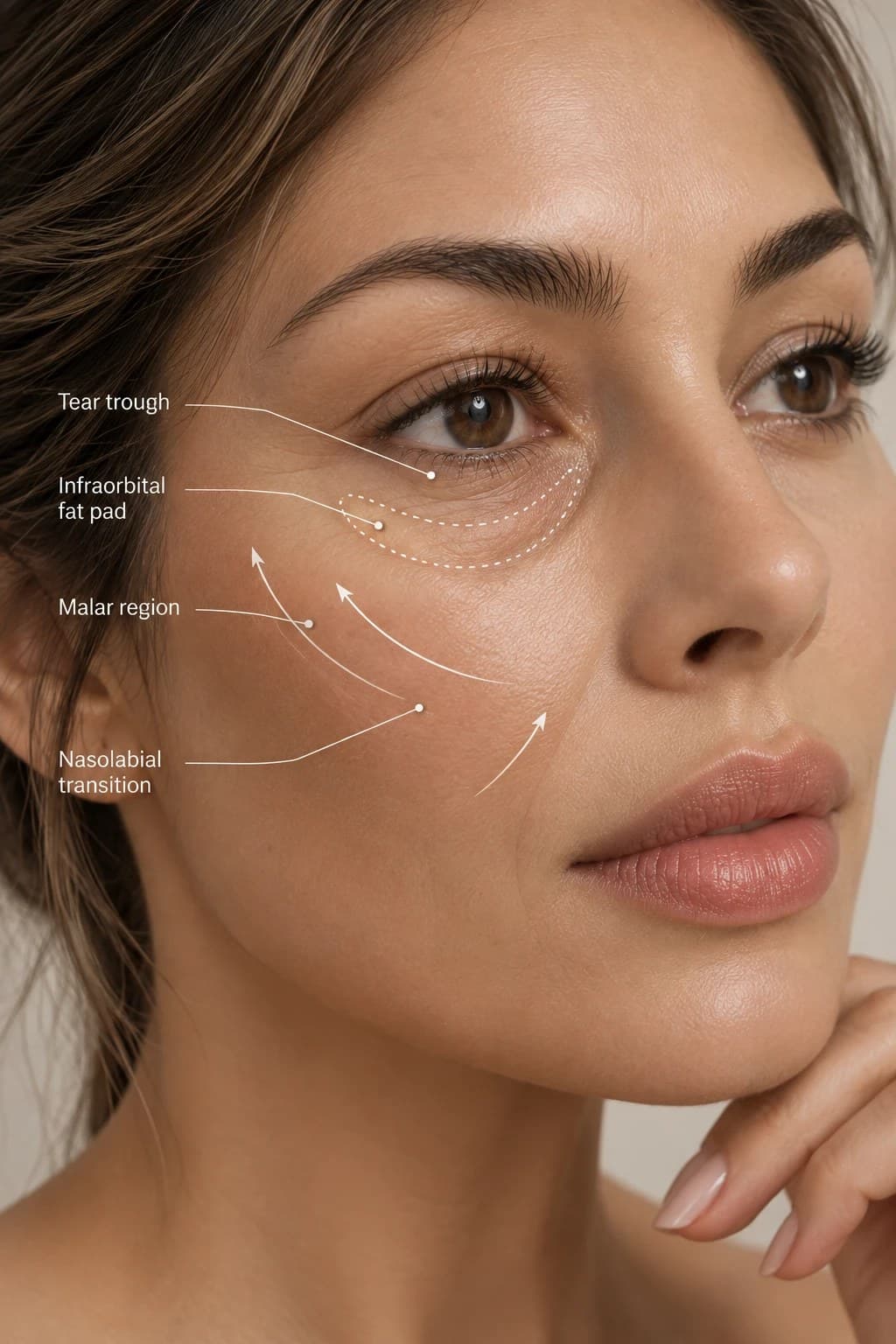
The skin of the lower eyelid is among the thinnest on the body, with very little fat directly beneath it. Deeper down, cushions of fat surround the eye, held back by a thin membrane that attaches to the bony rim of the eye socket. With age, the bony rim slowly remodels, the membrane can loosen so that fat pushes forward into a bag, and the thin skin gradually loses collagen and elasticity. Together these change how light falls across the area.
These changes are a normal part of ageing, and many people have under-eye shadows from a young age simply because of how their face is built. The area sits right beside the eye, and its skin marks and swells readily. Skincare and skin treatments may help pigment and texture for some people, but they do not change bone, fat or eyelid bags. If those bother you, a surgical opinion or leaving the area alone are reasonable choices, and a GP review often comes first.
Contributing factors
Why the under-eye area can look dark or shadowed
Genetics and face shape
Darker under-eye pigment often runs in families and is more common in people with olive, brown and Black skin. Deep-set eyes or a prominent brow can cast a shadow from a young age. This is normal variation, not a flaw.
Thin skin and visible vessels
Lower eyelid skin is very thin, so the network of small veins and the muscle beneath can show through as a blue or purple tone. Fair or thin skin makes this more visible, and it often looks darker when you are tired or unwell.
Age-related changes around the eye
With age, the bony rim of the eye socket slowly remodels, the fat around the eye can push forward into a bag, and the skin gradually loses collagen and elasticity. Together these can change how light falls on the area and create shadow. These changes are normal and happen to everyone, at different rates.
Sun and UV exposure
Ultraviolet (UV) light drives pigment production and breaks down the collagen that keeps skin firm. The under-eye area is often missed when applying sunscreen, and Queensland's UV levels are high year-round, so sun-related darkening, sunspots on the upper cheeks and crepey texture are common.
Allergies, eczema and rubbing
Hay fever and nasal congestion can slow drainage from the small veins under the eyes, causing darker, puffy areas sometimes called allergic shiners. Eczema, contact dermatitis and frequent rubbing inflame the skin, which can leave it darker and thicker over time.
Sleep, fluid and general health
Short or broken sleep, salty food, alcohol and lying flat can all increase fluid around the eyes, especially in the morning. Smoking speeds up skin ageing. Some medicines and eye drops, thyroid conditions and kidney problems can also change the area, which is why your health history matters.
Your consultation
Working out what is behind your dark circles
Under-eye concerns are rarely one thing, so the first job is working out what is causing yours. Your consultation is with Kirby Shannon (NMW0002042639), Registered Nurse (Division 1), general registration with the Australian Health Practitioner Regulation Agency (Ahpra). Kirby has more than ten years' experience in cosmetic and skin practice. She works within Oak's doctor-led team.
- Your concern in your own words, how long it has been there, and whether it changes with sleep, allergy season, illness or your menstrual cycle
- Your general health, including allergies, eczema, sleep, thyroid, kidney or heart conditions, eye conditions or past eye surgery, and current medicines and eye drops
- The colour of the area in daylight and under overhead light, to help separate pigment, visible vessels and shadow
- Skin thickness, crepey texture, elasticity and sun damage under the eye and across the upper cheeks
- Whether eyelid bags, excess eyelid skin or shadowing from the shape of the area are part of the picture, as skin treatments do not change these
- Your skin type, how readily it pigments or scars, and your sun, skincare and smoking habits
- Whether a GP review or referral should come first, and whether any cosmetic step is worthwhile at all
Approaches we may discuss
What may help under-eye skin, and when to leave it alone
There is no single answer for the under-eye area, and for many people the most useful steps happen at home. What may help depends on the cause. The options below are skincare, daily habits and non-surgical skin treatments, plus referral and no treatment. Any plan is individual and is decided with you after assessment.
Home care, daily habits and sun protection
Every day, use a broad-spectrum, water-resistant SPF 50+ (SPF 30 at a minimum) sunscreen, kept clear of the eye itself. SPF is the sun protection factor shown on the label. With wraparound sunglasses and a broad-brimmed hat, this reduces the sun exposure that deepens pigment and thins skin. Regular sleep, less salt and alcohol, not smoking, managing hay fever and not rubbing your eyes may reduce puffiness and darkening. For support to stop smoking, you can call Quitline on 13 QUIT (13 7848). A skin consultation can add an eye-area routine, such as niacinamide, vitamin C or a low-strength retinol, introduced slowly and patch tested first. Colour-correcting concealer or other make-up is a reasonable choice in its own right.
Learn moreSkin treatments for texture and tone
Microneedling, radiofrequency (RF) and in-clinic chemical peels work on the skin itself. Over a course of treatments, they may improve crepey texture, fine surface lines and uneven tone for some people. Near the eye they are adapted, and the skin by the lash line is left out. They do not change eyelid bags, bone or the fat beneath the skin. Suitability depends on your skin type, how readily you pigment and your history.
Learn moreLight and ultrasound devices, kept clear of the eye
IPL (intense pulsed light) uses filtered light to target sunspots and small visible vessels. It is not used on the eyelids or inside the bony rim of the eye socket, so its role for under-eye darkness is limited to the skin just below that rim. Focused ultrasound (HIFU) or RF may be discussed for mild skin laxity below the under-eye area, also kept away from the eye. Any change is usually modest, varies between individuals and is not comparable to surgery. Melasma (hormonal pigment) and darkening from rubbing or eczema can worsen with light or heat, so these are only considered after a careful look at the cause.
Learn moreMedical review and referral
If allergies, eczema, poor sleep, snoring, thyroid problems or fluid retention may be involved, a review with your general practitioner (GP) comes first, and treating the cause may make more difference than any cosmetic step. Pigment that is persistent, patchy or changing may be worth a dermatologist's opinion. Prominent eyelid bags or excess eyelid skin are structural, and are a question for an oculoplastic or plastic surgeon, which generally needs a referral from your GP. Kirby will explain why, and will refer you to your GP, another doctor or an emergency department when a medical assessment is needed.
A plan made for you, which may be no treatment
After assessment, Kirby explains what, if anything, is likely to be worthwhile for you, what it involves, the risks, recovery, number of visits and ongoing costs, in writing and before you consent. For many people the recommendation is home care, a GP review or leaving the area alone. You are welcome to take the plan home, seek a second opinion and decide later.
Learn more
What to expect
Your visit for dark circles, step by step
- 01
Consultation and a close look
You meet with Kirby. You talk through your concern, health history and skin habits, and the area is examined closely in good light. With your consent, clinical photographs are taken for your health record only. The consultation fee is confirmed when you book and is the only cost of that visit. Cosmetic consultations at Oak are for adults aged 18 and over.
- 02
Your options in writing, and time to think
If anything is recommended, you receive a written plan covering the likely cause, suitable and unsuitable options, risks, recovery, the number of visits that may be needed and all costs, including ongoing costs. Referral and no treatment are always included as options. You do not need to decide on the day, and you are welcome to seek a second opinion.
- 03
If you choose a skin treatment
Treatment is booked as a separate appointment. If a member of the team other than Kirby carries out your treatment, you are told beforehand who they are and what their qualifications are. Your skin is cleansed and checked again, your eyes are shielded during any light, heat or ultrasound device, and the skin closest to the lash line is treated differently or left out. What you feel varies between people, and we explain beforehand what is usual for the treatment you have chosen.
- 04
Caring for the area afterwards
You leave with written aftercare covering sun protection, what to avoid and for how long (such as rubbing, eye make-up, heat, strenuous exercise, swimming and active skincare), and which signs are expected and which need a call. Swelling around the eyes can be more noticeable than elsewhere. Depending on the treatment, some people plan anything from a day or two to a week or more away from work or social commitments.
- 05
Follow-up review
A follow-up appointment checks how your skin has responded and whether the plan still makes sense. Results vary between individuals. If something is not helping, you will be told so, and the plan can be changed or stopped.
Risks & recovery
Risks of skin treatments close to the eyes
Any cosmetic procedure near the eyes is a serious decision. The skin is thin, the eye needs protecting, and many causes of under-eye darkness respond poorly to treatment. The points below apply to the skincare and skin treatments described on this page. Your individual risks, recovery, the number of sessions and ongoing costs vary from person to person and should be explained, in writing, before you consent.
- Little or no visible change. Vascular darkness, inherited pigment, eyelid bags and shadowing from the shape of the area often respond poorly to skin treatments. You may complete a course and notice a modest difference, or none.
- Eye injury. Light, heat and ultrasound devices can injure the eye if it is not properly shielded or if they are used too close to it. Protective eyewear or shields are used, and some devices are not used on or near the eyelids at all.
- Pigment changes. Darker patches (post-inflammatory hyperpigmentation) or lighter patches can follow peels, microneedling, IPL or irritated skin. This is more likely in olive, brown and Black skin and with sun exposure after treatment. It can take months to fade and is occasionally permanent.
- Redness, swelling and bruising. The under-eye area swells readily, often most noticeably the next morning, and this can last several days. Pinpoint bleeding and bruising can occur with microneedling.
- Burns, blistering and scarring. These are uncommon but possible with RF, IPL, focused ultrasound (HIFU) and chemical peels, particularly on thin skin. Rarely, scarring near the lower lid can pull on the eyelid and change how it sits. Heat-based and focused ultrasound devices have also rarely been reported to cause numbness, which is usually temporary, and loss of fat under the skin, which can leave a hollow and may be long-lasting.
- Irritation, reactions and infection. Active skincare such as acids, retinol and vitamin C can sting, dry or inflame eyelid skin, and that inflammation can itself darken the area. Products applied to treated skin can cause allergic or irritant reactions, and treatments that break the skin, such as microneedling or peels, carry a small risk of infection.
- Recovery. This depends on the treatment, and near the eyes swelling is often more noticeable than elsewhere. After a light peel, expect redness for hours to a day, then flaking for a few days. A stronger peel can cause visible peeling, sometimes crusting, for a week or more. Microneedling causes redness, swelling and sensitivity for 1 to 3 days, sometimes longer, with possible pinpoint bleeding or bruising. RF causes redness and warmth for a few hours to a day or two, with swelling occasionally lasting longer. After IPL, redness lasts hours to a day or two, and treated pigment darkens then flakes over 1 to 2 weeks. After focused ultrasound (HIFU), tenderness can last a few weeks. Plan for careful sun protection and for avoiding heat, strenuous exercise and active skincare while the skin settles. Some treatments are uncomfortable, and how much varies between people.
- Ongoing commitment. Any improvement is not permanent, because ageing and sun exposure continue. How many sessions are needed and how often maintenance is required vary between individuals, and ongoing costs should be clear before you start.
When to seek urgent care
After any cosmetic procedure on or near the eyes, call 000 or go to the nearest emergency department for any change in vision, eye pain, swelling of the lips, tongue or throat, or difficulty breathing. Contact the clinic or your GP promptly for pain that is severe or getting worse, blistering, spreading redness or warmth, discharge, fever, or swelling that keeps increasing after the first two days. If the clinic is closed, contact an after-hours GP service or 13 HEALTH (13 43 25 84).
Questions to ask before any treatment near your eyes
- What is your registration type and number, and can I check it on the public register of the Australian Health Practitioner Regulation Agency (Ahpra)?
- What do you think is causing my under-eye darkness or shadowing, and how did you work that out?
- Is this likely to respond to treatment at all, and what happens if I do nothing?
- Which treatments are not suitable this close to the eye, and why?
- What are the specific risks for my skin type, including pigment changes and eye injury, and who manages complications, including after hours?
- How much recovery time should I plan for, how many sessions might I need, and what are the total and ongoing costs?
- Should I see my GP, or another doctor, before anything cosmetic is considered?
How can I tell what kind of dark circles I have?
There are some general clues. Brown tones are more often pigment. Blue, purple or pink tones are more often visible vessels. Darkness that lessens when you face a light directly is more often shadow from the shape of the area. These are only clues: most people have a mix, some skin conditions look alike, and an in-person assessment in good light is more reliable than a mirror check.
Can dark circles be a sign of a health problem?
Usually they are genetic, structural or lifestyle-related. See your GP if darkness or puffiness is new, affects one side only, or comes with weight change, tiredness, breathlessness or swelling elsewhere. See a doctor promptly if your eyes look more prominent, feel painful, or your vision changes. Hay fever, eczema, thyroid conditions, kidney problems and sleep problems such as sleep apnoea are all worth considering.
Will more sleep make a difference?
It may. Poor sleep can make the area puffier and darker for a day or two, and regular sleep, sleeping with your head slightly raised and managing hay fever may help with puffiness. Sleep will not change inherited pigment, visible vessels under thin skin, or shadowing from the shape of the area.
Will a skin treatment change eyelid bags or shadowing from the shape of my face?
Generally not. Skin treatments work on the skin itself. For some people they may improve crepey texture or pigment, but they do not change the bone, fat or eyelid bags behind most shadowing and puffiness. If bags, excess eyelid skin or shadowing from the shape of the area bother you, an oculoplastic or plastic surgeon can advise whether surgery is an option, which generally needs a referral from your GP. Colour-correcting concealer can soften shadows day to day, and leaving the area alone is also a reasonable choice.
Are eye creams worth it?
Some ingredients, such as niacinamide, vitamin C and low-strength retinol, may modestly improve pigment and texture with consistent use over several months. Caffeine and cool compresses may reduce puffiness for a few hours. No cream changes the structure under the eye, and a more expensive product does not mean a better result. Patch test new products, as eyelid skin reacts readily.
Why might I be advised not to have treatment?
The area sits beside the eye, the skin is thin and prone to swelling or marking, and many causes do not respond to cosmetic treatment. If the likely benefit is small, the risk is higher for your skin, or a medical cause needs attention first, the advice is to leave it. That is a normal outcome of an assessment, not a failure.
Other areas we assess
- Lines & facial movementRead more
- Facial shape & proportionRead more
- Lips & perioral areaRead more
- Skin quality & hydrationRead more
- Review & correctionRead more
This page is general information only and is not a substitute for individual medical advice. Cosmetic consultations are for adults aged 18 and over. Treatment is only offered where clinically appropriate following an in-person consultation with a registered health practitioner. All cosmetic procedures carry risks, and results vary between individuals.