Cosmetic consultations
Dry, dull or crepey skin, understood from the barrier up.
Dry, tight, dull or crepey skin usually has more than one cause. This page explains how the skin barrier holds water, how 'dry' and 'dehydrated' skin relate, and how sun and time change collagen and elastin. It also covers the skin services Oak offers, their risks and recovery, and when home care, a referral or no treatment may be the better choice.
Understanding it
How skin holds water, and why that changes
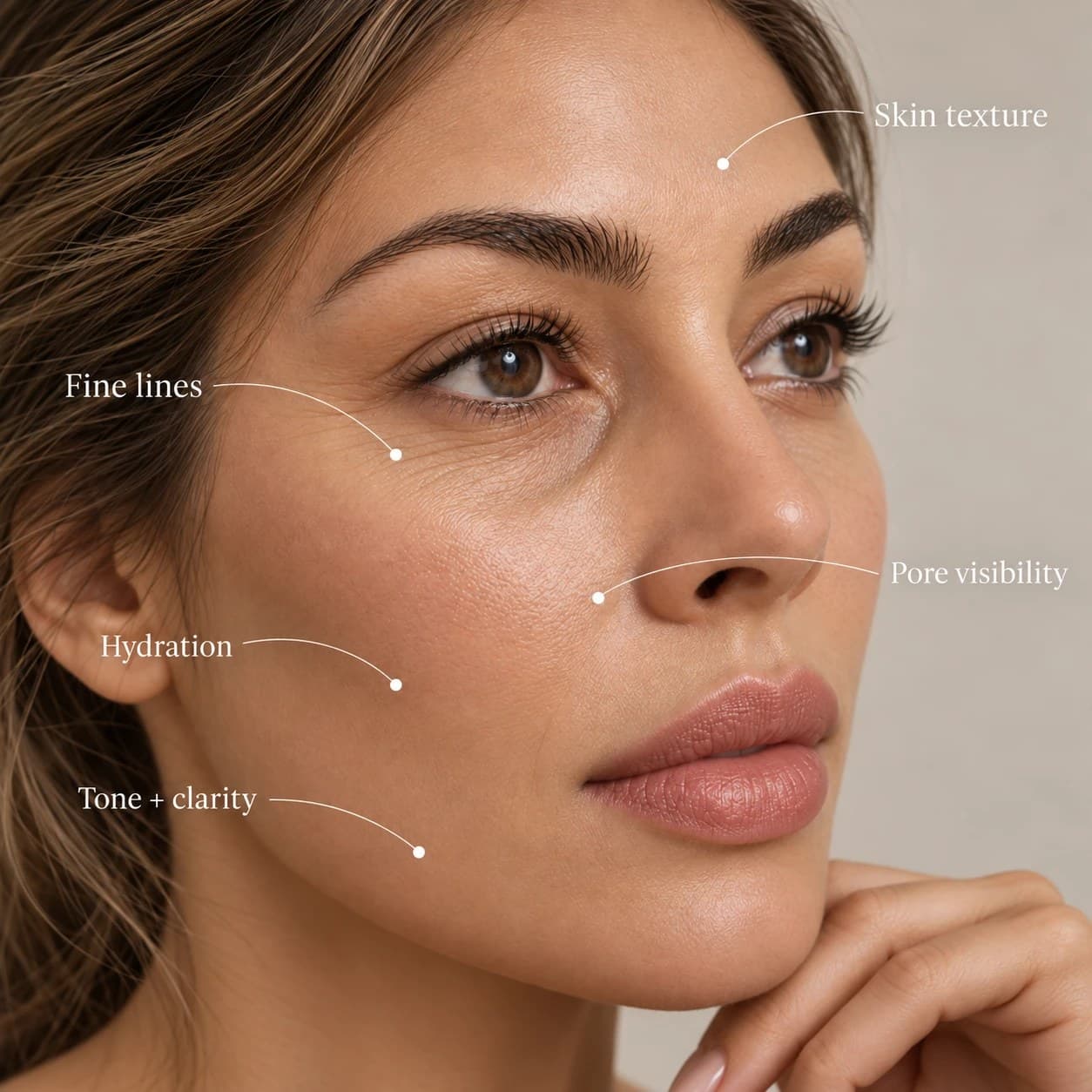
The outermost layer of skin, the stratum corneum, is only a fraction of a millimetre thick, yet it does most of the work of holding water in. It is often described as bricks and mortar: flattened skin cells held together by fats such as ceramides, cholesterol and fatty acids, along with water-binding compounds the skin makes itself. When this barrier is intact, skin tends to feel comfortable. When it is disrupted, more water evaporates, and skin can look dull, feel tight and sting with products.
Skincare often separates 'dry' skin, which makes less oil and feels rough or flaky, from 'dehydrated' skin, where the outer layer is short of water, something that can happen even in oily skin. Doctors tend to call both dry skin, because the usual underlying problem is a barrier letting too much water escape. That is why skin can look shiny by midday yet feel tight after cleansing, and why stripping oil with harsh cleansers or frequent scrubs often makes it worse.
Below it, the dermis gives skin its strength and spring: collagen provides structure and elastin lets skin recoil. Collagen production declines from early adulthood, the body makes little new elastin after growth ends, and many people notice faster change around menopause. Ultraviolet light adds to this by breaking down collagen and leaving elastic fibres damaged and disorganised. Over time the dermis thins and skin can take on a fine, crinkled, crepe-paper texture. This is a normal part of ageing that varies between people, not a disorder that needs correcting.
Contributing factors
What contributes to dry, dull or crepey skin
Year-round Queensland sun
In South East Queensland the UV index reaches 3 or above, the level at which sun protection is recommended, on most days of the year, including in winter. UVA reaches the dermis, passes through window glass and contributes to collagen breakdown, uneven pigment and visible small blood vessels. Daily broad-spectrum, water-resistant SPF 50+ (SPF 30 at a minimum), a hat, sunglasses, protective clothing and shade remain the foundation of long-term skincare, whatever else you choose to do.
Age, menopause and hormonal change
Skin cells renew more slowly with age, oil production falls and the dermis gradually thins. Falling oestrogen around perimenopause and menopause often brings noticeable dryness and thinner skin. Thyroid changes can also affect skin, which is one reason new or marked dryness is worth mentioning to your GP.
Routines that stress the barrier
Over-cleansing, hot water, grainy scrubs, cleansing brushes and layering several exfoliating acids or strong actives can all deplete the barrier's lipids. Heavily fragranced products can add irritation. If most products sting, a shorter routine with fewer products is usually the first step.
Dry air, hot showers and pools
Air conditioning, heating, low humidity, wind, long hot showers and chlorinated pools all draw water out of the outer layer of skin. Many people notice their skin feels tighter in winter or after a long flight.
Smoking, alcohol, sleep and weight change
Smoking reduces blood flow to the skin and speeds collagen breakdown. If you would like support to stop, Quitline is available on 13 QUIT (13 7848). Alcohol can cause flushing and dehydration, and ongoing poor sleep and stress may show in the skin. Significant or rapid weight loss can leave skin looking looser or crepey, because skin that has been stretched does not always fully recoil.
Skin conditions and medicines
Eczema, psoriasis, rosacea, an underactive thyroid and diabetes can all affect the skin barrier and how well it holds water, and some medicines can dry the skin. If dryness is new, severe, itchy or widespread, see your GP, who can refer you to a dermatologist if needed, before considering any cosmetic treatment.
Your consultation
Assessing dry, dull or crepey skin
Your consultation is with Kirby Shannon (NMW0002042639), Registered Nurse (Division 1), general registration with the Australian Health Practitioner Regulation Agency (Ahpra). Kirby has more than ten years' experience in cosmetic and skin practice. She works within Oak's doctor-led team. If another team member carries out any skin treatment, you are told who they are and their qualifications. A skin consultation is an assessment first. It looks at why your skin looks and feels the way it does before any treatment is discussed, and it may end with advice rather than a booking.
- Your concerns in your own words, when you first noticed them and what you have already tried
- Your medical history, medicines and supplements, allergies, pregnancy or breastfeeding, and any history of cold sores, keloid scarring or pigment changes after injury
- Your skin type and tone, and how your skin reacts to sun, heat and inflammation, which affects the risk of pigment change after peels, IPL and microneedling
- Signs of barrier stress, such as tightness, flaking, stinging with products, redness or congestion
- Sun damage, pigment and visible blood vessels, and any spots that should be checked by a doctor before a device is used over them
- Your current routine, product by product, including how often you exfoliate
- Your goals, budget and the recovery time you can realistically allow, and whether treatment is needed at all
Approaches we may discuss
What may help dry, dull or crepey skin
There is no single answer for dry, dull or crepey skin. Most plans start with home care, and some add in-clinic services over time. Each option below has limits and risks, and none of them stops skin from ageing. What suits you depends on your assessment.
Barrier repair and a home-care plan
A home-care plan often starts by taking things away: fewer products, a mild non-foaming cleanser, lukewarm water and a pause on scrubs or stacked acids. It then adds what the barrier needs: a moisturiser with humectants such as glycerin to attract water, lipids such as ceramides to help hold it in, and broad-spectrum, water-resistant SPF 50+ (SPF 30 at a minimum) every morning. Actives such as vitamin C or niacinamide may be introduced slowly once skin is comfortable. The skin surface takes roughly four to six weeks to renew, often longer with age, so give a routine about that long before judging it.
Learn moreHydraFacial, clinical facials and chemical peels
A HydraFacial is a multi-step, machine-assisted facial: skin is cleansed, exfoliated with a mild acid solution and cleared with a suction tip, then serums, which may include antioxidants, are applied to the surface. Sensation varies: it can feel like cool, wet suction, and some people find parts of it uncomfortable. Redness for a few hours is common, and some people notice sensitivity or breakouts over the next few days. Any change is mostly at the surface and temporary. Clinical facials use cleansing, exfoliation and products chosen for your skin. In-clinic chemical peels use acids such as lactic, glycolic or salicylic acid to loosen dead surface cells. After a light peel, expect redness for hours to a day, then flaking for a few days. A stronger peel can cause visible peeling, sometimes with crusting, for a week or more, and strict sun protection is needed afterwards. Peels are chosen for your skin tone and sensitivity, and some skin is better suited to a milder option or none.
Learn moreMicroneedling and RF devices
Microneedling (also called skin needling) uses a device with very fine points to make many tiny, controlled injuries in the skin. The repair response that follows aims to support new collagen over several months, and some people notice an improvement in texture or some types of acne scarring, although results vary. It is usually done as a course spaced several weeks apart. Redness, swelling and sensitivity for 1 to 3 days, sometimes longer, are common, with possible pinpoint bleeding or bruising, and many people find it uncomfortable. RF (radiofrequency) devices heat deeper layers of skin with the aim of encouraging collagen remodelling, and the heat can feel intense. Redness and warmth for a few hours to a day or two are common, with swelling occasionally lasting longer. For crepey skin and mild laxity, any change from either treatment is gradual and modest, some people notice little difference, maintenance is usually needed, and neither is a substitute for surgery.
Learn moreIPL and LED light therapy
IPL (intense pulsed light) uses filtered flashes of light to target brown sun spots and small visible blood vessels, which can make skin look uneven and dull. Each flash can feel like a sharp sting with heat. Redness usually lasts for hours to a day or two, and treated pigment darkens then flakes over 1 to 2 weeks. A course is usually needed. IPL is not used on tanned skin, over spots that have not been checked by a doctor, or for some deeper skin tones. It can worsen melasma, and a test patch may be recommended. LED light therapy uses low-level light at set wavelengths and is usually an add-on to other care. Eye protection is needed, it may not suit people taking medicines that increase light sensitivity, and the evidence for cosmetic benefit is limited.
Learn moreA written plan, which may mean no clinic treatment
After your assessment you receive a written plan. It may combine home care with one or more of the services above, spaced to suit your skin, budget and recovery time. It may instead be a plan to change your routine, protect your skin from the sun and review in a couple of months, with no clinic treatment at all. If something such as a changing spot, persistent redness or a rash needs checking, Kirby will explain why, and will refer you to your GP, another doctor or an emergency department when a medical assessment is needed. Seeing a dermatologist usually starts with a referral from your GP.
Learn more
What to expect
Your visit for dry or crepey skin, step by step
- 01
Consultation and skin assessment
Your first appointment is a consultation, not a treatment, and consultations are for adults aged 18 and over. Your consultation is with Kirby. She looks at your skin in good light, talks through your history and routine, and may take clinical photographs for your confidential record with your consent. If another team member will carry out a skin treatment, you are told who they are and their qualifications. The consultation fee is stated when you book and is separate from the cost of any treatment.
- 02
A written plan to take home
Your plan sets out the suggested services, how many sessions may be needed, expected recovery, likely maintenance and total costs, including ongoing costs. You are welcome to take it home and think it over. Cosmetic treatment is a serious decision. Home care alone, an opinion from your GP or a dermatologist, or no treatment at all are always options.
- 03
Preparing for treatment
Depending on the service, you may be asked to pause exfoliating acids or strong actives for several days, avoid tanning, and tell us about any new medicines, skin changes or cold sores. A test patch may be done before a peel or IPL.
- 04
On the day
Skin is cleansed and checked again, and eyes are protected for light-based treatments. Sensation varies between people and treatments, from cool and wet to hot, prickly or stinging, and some people find treatment uncomfortable or painful. The person treating you checks in with you throughout and will stop if you ask. You leave with sunscreen applied and written aftercare.
- 05
Aftercare and a follow-up review
Depending on the treatment, for a day to a week or more you may need to avoid make-up, heavy exercise, saunas, swimming and strong actives, and keep out of the sun, so plan any events around this. We review how your skin has responded, usually within a few weeks, and adjust the plan. Results vary between individuals and are not permanent, because skin keeps ageing and responding to the sun.
Risks & recovery
Risks of facials, peels and skin devices
Every cosmetic skin procedure carries risk, including the services described on this page. We set the risks out here so you can read them before you book, and we go through those that apply to you, along with recovery time and costs, before you consent. Sensation, recovery and results differ from person to person.
- Recovery differs by treatment. After a facial, redness for a few hours is common, and some people notice sensitivity or breakouts over the next few days. After a light peel, expect redness for hours to a day, then flaking for a few days. A stronger peel can cause visible peeling, sometimes with crusting, for a week or more. Picking or scrubbing at peeling skin or crusts increases the risk of marks and pigment change.
- Microneedling commonly causes redness, swelling and sensitivity for 1 to 3 days, sometimes longer, with possible pinpoint bleeding or bruising. Uncommonly, it leaves grid-like marks or scarring.
- RF can cause redness and warmth for a few hours to a day or two, with swelling occasionally lasting longer. Heat-based and focused ultrasound devices have also rarely been reported to cause numbness, which is usually temporary, and loss of fat under the skin, which can leave a hollow and may be long-lasting.
- After IPL, redness usually lasts for hours to a day or two, and treated pigment darkens then flakes over 1 to 2 weeks. Reactive skin can take longer to settle after any of these treatments.
- Pigment change: darker patches (post-inflammatory hyperpigmentation) or, less often, lighter patches can follow peels, microneedling, IPL and RF, and heat or light can worsen melasma. The risk is higher in deeper skin tones and tanned skin. These changes can take months to fade and are occasionally permanent.
- Burns, blisters and scarring are uncommon but possible with IPL, RF and stronger peels, particularly on tanned or sensitised skin or when aftercare is not followed. Bright light can injure the eyes, so protective eyewear is used for IPL and LED.
- Infection, a flare of acne or rosacea, milia (tiny white bumps) and reactivation of cold sores. If you get cold sores, tell us, as treatment may need to be delayed or you may be asked to see your GP first.
- Allergic or irritant reactions to peel solutions, serums or skincare products.
- Results vary between individuals. Some people see little visible change, most services need several sessions, and any improvement needs ongoing home care and maintenance, with ongoing costs. How soon any change appears, how long it lasts and how often maintenance is needed also vary, and are explained with costs before you consent.
When to seek urgent care
Seek prompt medical care if, after any skin treatment, you notice spreading redness, heat or pus, fever, blistering or burns, or severe or worsening pain: contact the clinic that treated you or your GP. Eye pain or any change in your vision after a light-based treatment needs same-day assessment by a doctor or an emergency department. For health advice at any hour, call 13 HEALTH (13 43 25 84). Call 000 in an emergency, such as swelling of the face, lips, tongue or throat, or difficulty breathing.
What to ask before a peel, facial or skin device
- Who will carry out my treatment, what are their qualifications, and if they are a registered health practitioner, can I check their registration on the public register at ahpra.gov.au?
- For IPL or laser, does the person treating me hold a current Queensland licence to use the device?
- Is this treatment suitable for my skin tone and history, and what is my personal risk of pigment change or scarring?
- What recovery should I plan for, what are the common and the rare risks, and what does aftercare involve?
- How many sessions are likely, how long might any change last, and what is the full cost including maintenance?
- Who do I contact if I have a problem, including after hours?
- What would you suggest if I chose home care only, or no treatment?
How do I tell whether my skin is dry or dehydrated?
In skincare, 'dry' usually describes skin that feels rough, flaky or itchy much of the time and makes little oil, while 'dehydrated' describes skin that feels tight, looks dull or shows fine crinkling that softens after moisturiser, even if it is oily. Doctors generally treat both as dry skin with a stressed barrier. Many people have a mix, and it can change with the season, air conditioning and the products you use. An in-person assessment helps work out what your skin needs.
Does drinking more water help dry skin?
Drinking enough water matters for general health, and being significantly dehydrated can show in the skin. For most healthy people, though, drinking more than they need has only a small effect on the outer layer of skin, which loses water to the air. Barrier care, moisturiser, sun protection and avoiding harsh products usually make a bigger difference to how dry skin looks and feels.
Can facials or devices reverse crepey skin?
No treatment reverses ageing. Facials and peels can improve how skin looks and feels for a while. Microneedling and RF aim for gradual collagen change; some people notice a modest improvement in texture and firmness over several months, and others notice little difference. Where skin laxity is more marked, surgery may be worth discussing, and your GP can refer you to a specialist plastic surgeon. Choosing no treatment is also a reasonable decision.
Is there a better time of year for peels, IPL or microneedling?
Many people plan them for the cooler months, when they are outdoors less and less likely to have a tan. In Queensland, though, UV levels are high enough all year that daily broad-spectrum, water-resistant SPF 50+ (SPF 30 at a minimum) and sun avoidance after treatment are needed in every season.
Can I have skin treatments if I am pregnant, breastfeeding or have a medical condition?
Some peels, acids and devices are deferred during pregnancy and breastfeeding. RF is not used for people with a pacemaker or some other implants, and some medicines, whether taken by mouth or applied to the skin, can change how skin heals or make it more sensitive to light. Please bring a list of your medicines and conditions to your consultation. If a service is not suitable for you, we will tell you.
Can people under 18 book a cosmetic consultation?
No. The cosmetic consultations described on this page are for adults aged 18 and over. If a young person has a skin concern such as acne or eczema, a GP is a good first step.
Other areas we assess
- Lines & facial movementRead more
- Facial shape & proportionRead more
- Lips & perioral areaRead more
- Under-eye & mid-faceRead more
- Review & correctionRead more
This page is general information only and is not a substitute for individual medical advice. Cosmetic consultations are for adults aged 18 and over. Treatment is only offered where clinically appropriate following an in-person consultation with a registered health practitioner. All cosmetic procedures carry risks, and results vary between individuals.